
Electricity Storage on the Road to 2030
As we approach the middle of the decade, Greece continues to build new energy projects and upgrade the infrastructure needed to meet its 2030 targets and lay the foundations for 2050. This work is guided by European policy, including the European Green Deal and Fit for 55, and by Greece’s own National Energy and Climate Plan (NECP) and Climate Law.
Rapid growth in renewables is placing new demands on the power system and raising technical and economic challenges that call for immediate action. Greece urgently needs systems to store the electricity its renewable plants generate, and a clear, dependable regulatory framework for their operation.
Why is it so urgent to bring electricity storage onto the system? The sheer number of renewable projects operating or under development has become practically unmanageable. In 2024, installed renewable capacity in Greece reached 13 GW. A further 16 GW of projects had secured grid connection offers and were awaiting connection. Pending applications represented more than 40 GW, bringing the total to nearly 70 GW before counting future projects still at the planning stage.
Renewable generation exceeds demand at certain times of day, and its output is inherently variable. Together, these factors make it harder to manage the grid capacity available and balance supply and demand, and they can drive marginal electricity prices down to zero. They also create opportunities for electricity storage systems to stabilise the grid and make fuller use of renewable resources, supporting a transition to greener energy that is both economically viable and technically secure.
Electricity storage systems that can participate in the electricity markets are therefore urgently needed. They will help smooth price swings over the course of the day, a particularly pressing issue, and lower the final cost of electricity. Deploying storage alongside renewables will also make it easier to manage the electricity generated, increase the share of renewables and bring electricity prices down further.
The updated NECP identifies adequate storage power and energy capacity as essential. By 2030 it envisages 4.3 GW of battery storage and 1.7 GW of pumped storage, a total of 6 GW.
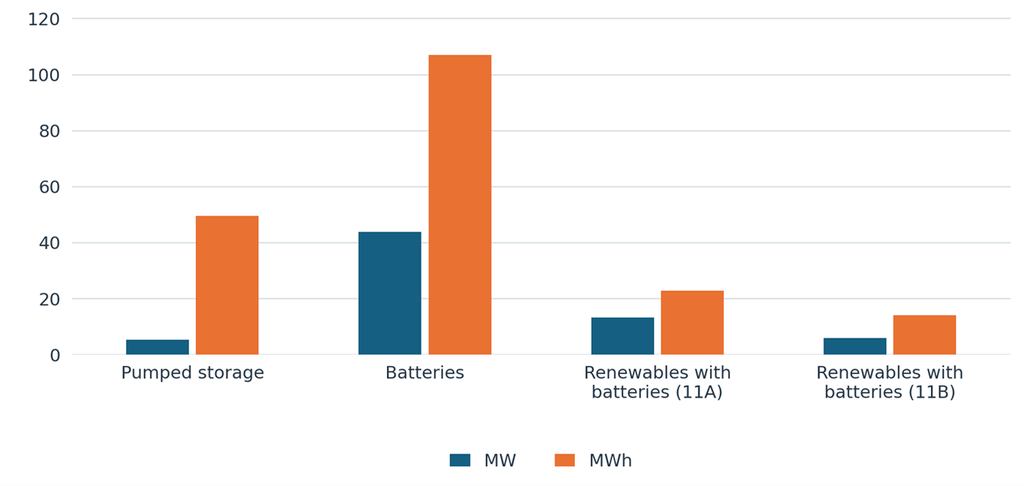
The licensing register of the Regulatory Authority for Waste, Energy and Water (RAAEY) shows that licensed electricity storage systems and hybrid projects combining renewables with storage already far exceed the NECP projections. Battery storage licences cover more than 40 GW of power and over 100 GWh of energy capacity. Pumped storage licences account for 5.26 GW and 50 GWh respectively. Licences for ‘special projects’ combining renewables and storage under Article 10(11B) of Law 4685/2020 add a further 6 GW of renewable generating capacity and 14 GWh of storage.
Including licensed renewable projects in category 11A and hybrid projects on the islands brings the total to nearly 70 GW of storage power and 200 GWh of energy capacity. These figures show the strength of investor interest in developing electricity storage systems.
At present, the only electricity storage systems operating in the Greek market are the older hydropower plants with pumping capability, with a combined installed capacity of around 700 MW. Rising curtailment of renewable generation and the appearance of zero prices in the day-ahead market suggest that the country’s power system has reached its limits. Both trends pose serious challenges for the immediate future.
Under Law 4951/2022, the Greek government planned three tenders to provide financial support for 1 GW of large-scale storage. The first two were successfully completed in 2023. Unfortunately, it proved impossible to hold the third and final tender in 2024. It covered the remaining 300 MW, with a storage duration of four hours, equivalent to 1,200 MWh.
The following issues remain to be resolved in 2025.
- Completing the regulatory framework requires urgent decisions on the detailed rules for storage systems’ participation in the electricity markets, particularly the balancing market.
- Publishing the methodology for annual support will clarify how and when payments will be made, how long the regulatory period will last and how projects will be grouped.
- Static operating restrictions should be lifted so that storage plants can make full use of the flexibility their technology offers in the electricity markets.
- Launching the third tender is essential to completing the storage support programme. Plants seeking to participate in the markets without support should be able to secure a grid connection without delay.
- A mechanism to remunerate available capacity should be introduced, with competitive procedures established without delay.
- Hybrid projects combining storage and renewables should be promoted. Projects in category 11B under Article 10 of Law 4685/2020 offer one of the most flexible ways to integrate more renewable power into the system.
In 2024, Greece took steps in the right direction to increase the share of renewables and make its energy sector more competitive. There were also serious delays. 2025 must be a landmark year for electricity storage, and it is the year we expect the first new storage projects to come into operation!