
The transition to a greener, more sustainable future is one of Greece’s most important energy policy goals. It will give the country the resilience it needs as crises become more frequent and help it compete internationally as conditions change.
Greece must therefore make the most of its own energy resources, including renewables such as solar and wind. One encouraging sign is that in 2024 renewables, including large hydropower plants, accounted for 56% of the country’s electricity generation.
As more electricity comes from renewables such as solar and wind farms, the national power system faces new demands. One of the most pressing is how to manage fluctuations in their output and the uncertainty over how much electricity they will produce.
Electricity storage has a particular role here. It is the principal means of stabilising a power system that relies on intermittent sources.
In 2024, Greece’s installed renewable generating capacity reached 13 GW. A further 16 GW of projects had secured grid connection offers and were awaiting connection. Applications still pending represented more than 40 GW, bringing the total to nearly 70 GW even before counting future projects still at the planning stage.
Renewable generation already exceeds demand at certain times of day when consumption is low. This makes it harder to balance the system and can push electricity prices to zero or below. It also opens up opportunities for electricity storage systems to stabilise the grid and make fuller use of renewables, helping Greece move towards greener energy while maintaining the security and economic viability of its electricity supply.
Electricity storage systems that can trade in the electricity markets therefore need to be built as soon as possible. They can smooth price swings over the course of the day, a particularly pressing issue, and help bring down the cost that consumers ultimately pay for electricity. Pairing storage with renewables will also allow us to manage the electricity generated more effectively, increase the share of renewables and keep the energy transition on a secure footing.
The updated National Energy and Climate Plan (NECP) identifies adequate storage power and energy capacity as essential. By 2030 it envisages 4.3 GW of battery storage and 1.7 GW of pumped storage, a total of 6 GW.
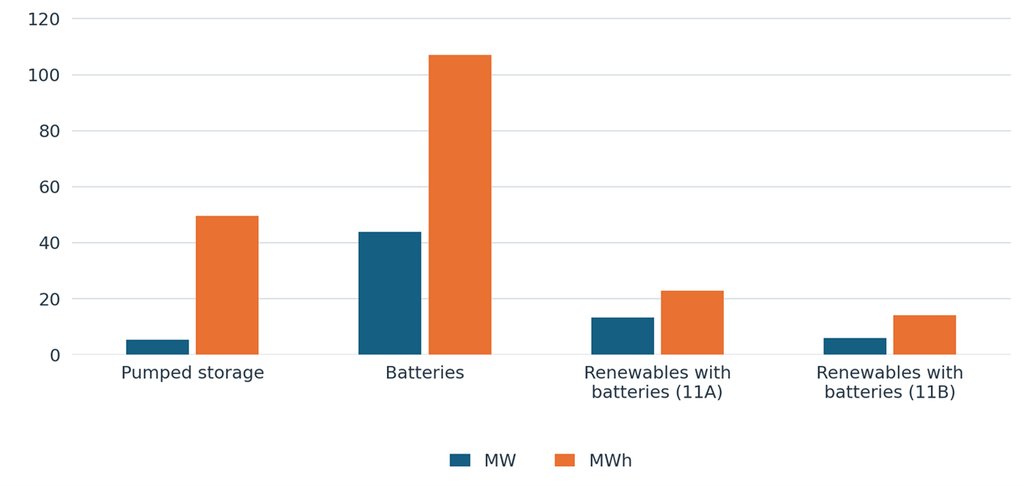
The licensing register of the Regulatory Authority for Waste, Energy and Water (RAAEY) shows that licensed electricity storage systems and hybrid projects combining renewables with storage already far exceed the NECP projections. Battery storage licences cover more than 40 GW of power and over 100 GWh of energy capacity. Pumped storage licences account for 5.26 GW and 50 GWh respectively. Licences for ‘special projects’ combining renewables and storage under Article 10(11B) of Law 4685/2020 add a further 6 GW of renewable generating capacity and 14 GWh of storage.
Including licensed renewable projects in category 11A and hybrid projects on the islands brings the total to nearly 70 GW of storage power and 200 GWh of energy capacity. These figures show the strength of investor interest in electricity storage, encouraged by the sharp fall in the cost of lithium batteries and other storage technologies.
The legal and regulatory framework
Until recently, uncertainty about the Greek regulatory framework for storage deterred investment. Since 2022, however, considerable work has gone into clarifying the rules, and storage is now recognised as having a distinct role in the energy mix.
Two years ago, in response to the shortage of electricity storage systems, the government scheduled three tenders to support the rapid installation of 1 GW of storage. The first two concluded in 2023 and the third only in early 2025. In response to strong investor interest, the Ministry of Environment and Energy also plans to auction 3.55 GW of grid connection capacity this year for stand-alone merchant battery systems. These projects would receive priority for grid connection offers, without state aid. Under the draft ministerial decision put out to public consultation in late February, 2.65 GW would be available for projects connecting to the Independent Power Transmission Operator’s grid and 900 MW for those connecting to the Hellenic Electricity Distribution Network Operator’s grid. Together with the 900 MW already allocated through the completed tenders, the planned call is intended to meet the NECP’s 2030 target of 4.3 GW of battery storage as soon as possible.
At present, the only electricity storage systems operating in the Greek market are the older hydropower plants with pumping capability, with a combined installed capacity of around 700 MW. The latest information also suggests that the first new storage projects will enter service in the first half of 2026, later than originally expected in 2025. Meanwhile, rising curtailment of renewable generation and the appearance of zero prices in the day-ahead market suggest that the country’s power system has reached its limits. Both trends pose serious challenges for the immediate future.
Conclusion
Considerable work has gone into regulatory reform and the introduction of clear operating rules for storage systems. Several issues still need to be resolved before the framework is complete.
Electricity storage is a cornerstone of the energy transition in Greece and internationally. With the right combination of technology, political will and funding, Greece can become a leader in green energy in south-eastern Europe. The stakes are high, and the momentum is encouraging.